A new era for European science: EUDAT helps move the EOSC Federation into operations
Europe has reached an important milestone in the way researchers access and use data. In October 2026, at the European Open Science Cloud (EOSC) Symposium in Florence, Italy, the EOSC Federation will formally move into operations, connecting research data, services and infrastructures across countries, institutions and disciplines. Twenty-eight national, thematic and infrastructure EOSC Nodes—supported by 218 European research organisations—are currently working toward production, with dozens more preparing to join in the coming years.
The science already shows what this can mean. EOSC Federation use cases include combining genomic, environmental and modelling data to understand how marine microorganisms contribute to carbon sequestration; enabling cross-border analysis of pathogen genomes for outbreak detection and antimicrobial-resistance surveillance; training AI models to improve prostate-cancer screening; and allowing researchers to discover data within, and to run computational workflows close to, the enormous datasets produced by Europe’s large-scale research infrastructures like CERN.
For EUDAT, a production-grade EOSC Federation is both a European achievement and a testament to the possibility of cross-border collaboration. Through the EOSC Node build-up, EUDAT contributes interoperable and fully customisable set of research services to the Federation.
The scientific capability enabled by the EOSC Federation also contributes directly to wider European policy objectives concerning data sovereignty, security and Europe’s AI and innovation ambitions. The timing is particularly important as research becomes more data-intensive and increasingly shaped by artificial intelligence. AI-enabled science depends on access to high-quality, trustworthy and well-described data and metadata. By connecting Europe’s research resources in a trusted environment, EOSC can help create the conditions for new scientific tools and services to be developed in Europe and beyond.
For EUDAT, participation therefore means more than access to European infrastructure. It gives national research resources greater reach, enables researchers to participate in cross-border science at scale, and ensures that EUDAT helps shape the European environment in which future data-intensive research will take place.
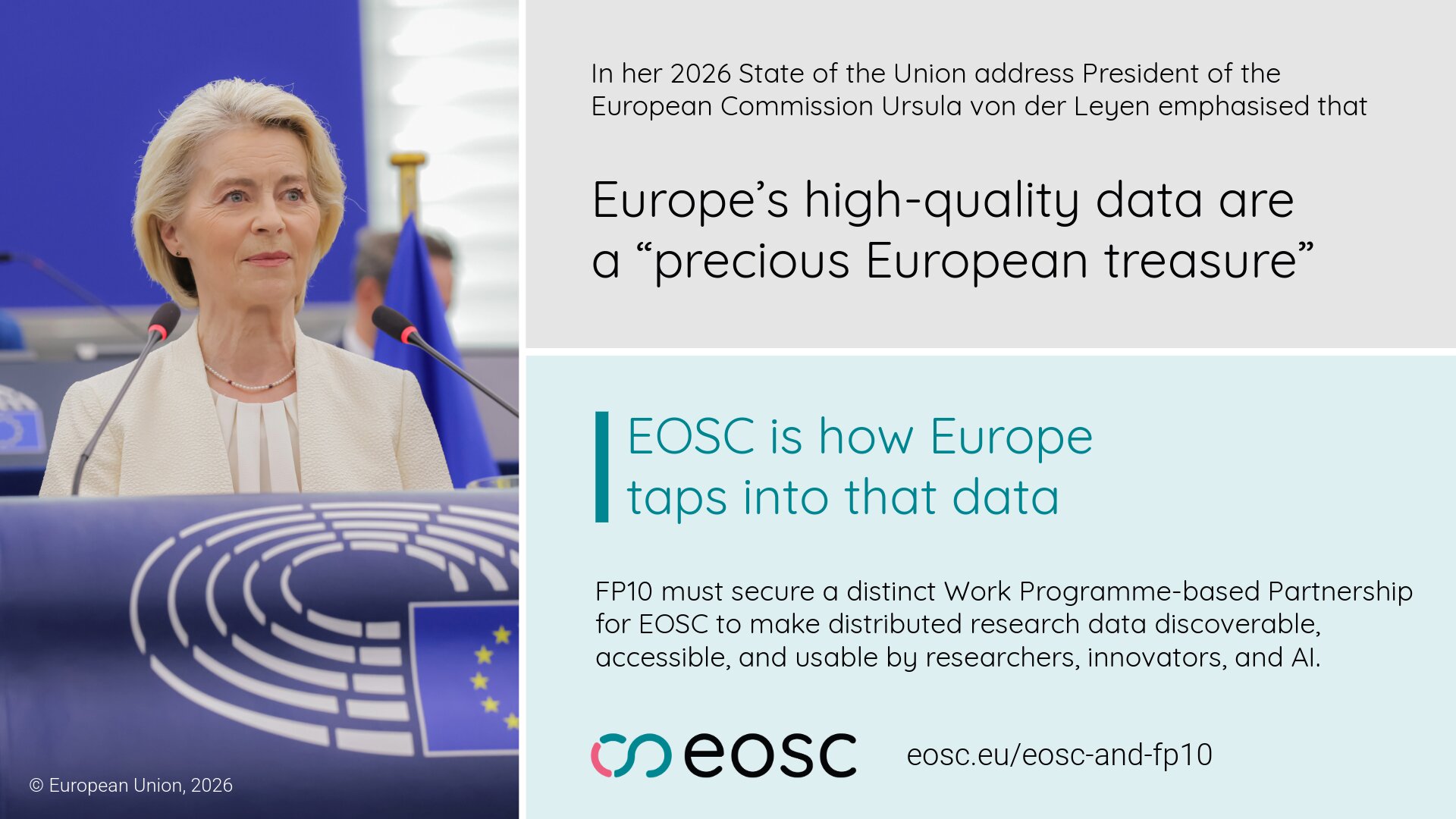
Work now continues to improve the researcher experience, expand the scientific scope and reach of the Federation and consolidate its operation across Europe. To put EOSC on sustainable ground as it enters its growth phase, the EOSC Association, representing the European research community, and the EOSC Steering Board, representing the countries, have both called for a distinct Work Programme-based Partnership in the Union’s next framework programme, FP10. The European Commission has likewise signalled its strong support for the “backbone of Europe’s digital research and innovation ecosystem”.
Experience the EOSC Federation via the EOSC EU Node: https://open-science-cloud.ec.europa.eu
Explore the EOSC Federation’s Nodes and scientific use cases, and learn more about how it is being built and by whom: https://eosc.eu/building-the-eosc-federation
EOSC and FP10: https://eosc.eu/eosc-and-fp10
Did you like this content? Share it with your network!